Chief Information Officer and Chief Security Officer

Redefining the AI Workforce: Insights from Ireland’s International AI Summit
October 20, 2026
A job is more than a paycheck. It provides a livelihood, a sense of purpose and the opportunity to build a future. That is what makes the choices we make about AI and work so consequential.
Last week, I joined government, industry, and academic leaders at the International AI Summit in Dublin, hosted under Ireland’s Presidency of the Council of the European Union. Representing Indeed alongside peers from Cisco, IBM, and Ibec, I took the stage for a discussion central to our mission: “The AI-Powered Workforce: Redefining Work, Skills and Opportunity.”
The conversation reinforced a conviction I bring to my work at Indeed: greater technological capability needs to translate into better outcomes for people.
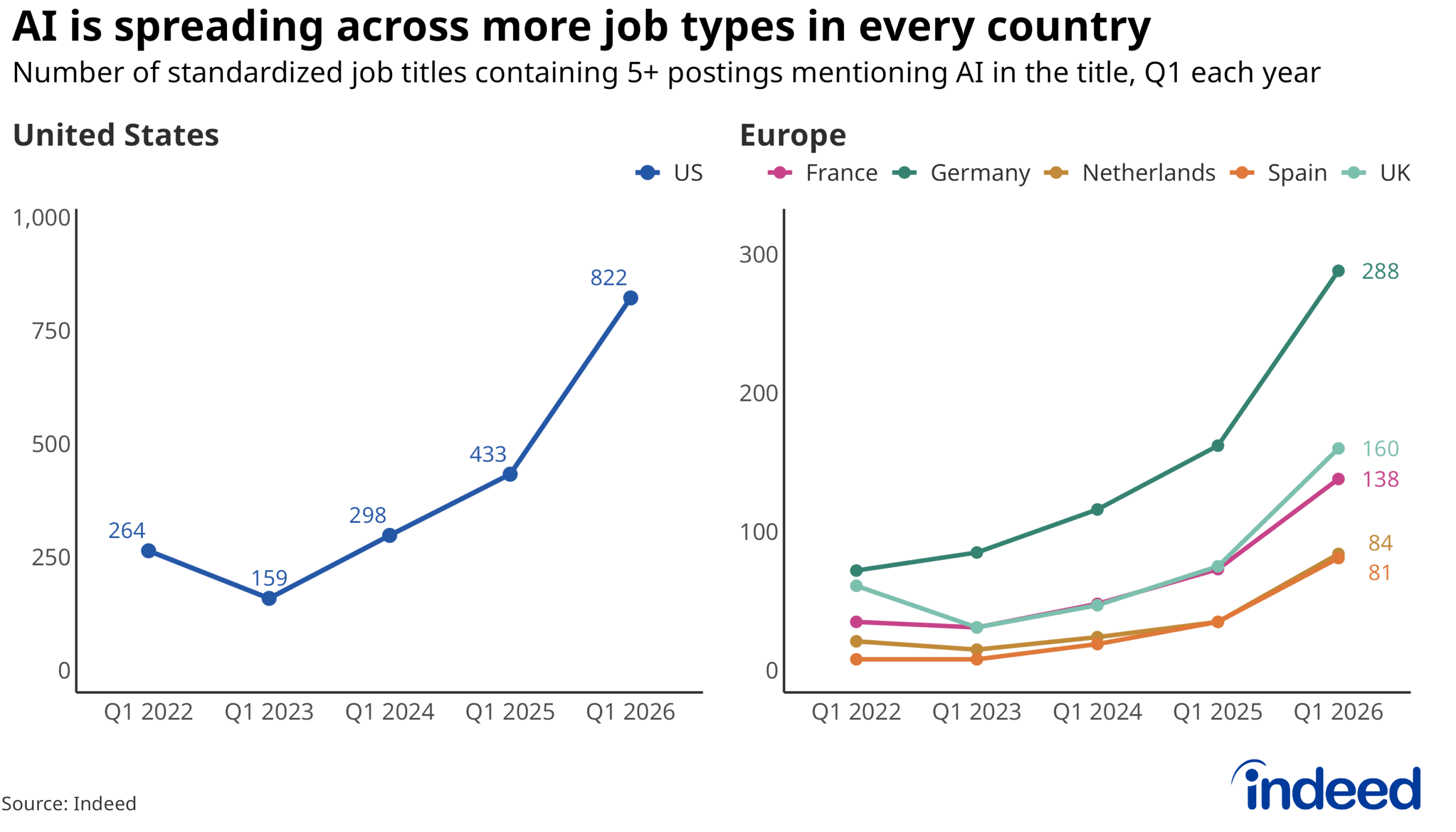
No one at the summit was debating whether AI will affect work. That is already happening; the labor market is already showing this shift with the number of job titles mentioning AI rising in the United States and across Europe.
The real test now for leaders, policymakers, and educators is action: how we redesign work, prepare people for the transition, and scale AI capability without losing human trust and connection.
Start with the task, not the headline
Research from Indeed Hiring Lab finds that nearly half of the skills in a typical US job posting have the potential for deep transformation by generative AI. That means looking closely at how work gets done: which tasks AI can handle, where people need to exercise judgment, and how those responsibilities fit together.
What excites me most is the capability this can unlock. Removing toil gives people room to investigate problems they previously couldn’t reach, discover opportunities they might have missed, and put more energy into solving them. The measure of success is what we accomplish with that capacity: better decisions, better work and better outcomes for the people we serve.
Realizing that opportunity takes joint effort: leaders setting clear priorities and providing trusted tools, and employees experimenting to help shape how technology fits into their daily work. At Indeed, our experience reinforces the importance of combining leadership top down direction with practical feedback from the people using the tools.
The goal is to help people become AI-literate, not AI-dependent. We need the knowledge to evaluate AI outputs, provide our subject matter expertise, recognize AIs limitations and ultimately be accountable for what happens next. Curiosity, adaptability, communication and collaboration become essential to making these tools useful. We should be building people’s confidence and capability to keep learning as the work changes.
Embed Learning into the Workflow
The conversation returned several times to the importance of creating space for people to learn. That sounds straightforward, but it is one of the harder organizational changes.
Training cannot be treated as a one-off intervention. It needs to be part of the workflow, supported by leaders and connected to the work people are actually doing. Employees need to understand what is changing, why it is changing and be empowered to participate in shaping the outcome.
This is especially critical for small and medium-sized businesses (SMBs). While enterprise organizations have the resources to experiment, many SMBs do not have the same bandwidth. Closing this gap doesn’t require massive L&D budgets; simple, peer-led sessions can help teams share low-stakes experiments. Without these accessible spaces, we risk creating a two-tier economy divided between AI-enabled businesses and those left behind.
Protecting the Early-Career Pipeline
The most personal part of the conversation for me was the discussion about early-career work.
Early-career work is where people build confidence, gain practical experience, and discover what they can contribute. While these opportunities face pressure across several markets, we should be careful about attributing the broader hiring slowdown entirely to AI.
But employers face a clear responsibility: as we automate work, we must preserve the opportunity to learn. Judgment develops through practice, feedback and increasing responsibility. If AI takes on tasks that traditionally helped people gain experience, we need to create new ways for them to develop through meaningful assignments, mentoring, rotations and redesigned graduate programs.
I remain optimistic about early-career talent. New colleagues bring fresh perspectives, serve as invaluable “reverse mentors”, and bring questions that can challenge established assumptions. They need opportunities to contribute and experienced colleagues willing to invest in their development.
Ireland offers an encouraging signal of what happens when employers invest: new graduate job postings were up 4% year over year, even as overall postings were down 6%.
The experienced workforce we will need tomorrow depends on the opportunities we create today.
Trust: The Engine of Scalable Innovation
The EU AI Act underlines something fundamental: scaling AI only works if you build in trust and keep human judgment at the center.
That theme echoed throughout the summit. In my work as CIO and CSO, I see how clear safeguards give teams the confidence to adopt technology and expand its use.
That starts with practical questions: What data can the system access? How is performance evaluated? Who is ultimately accountable, and can a human intervene when something goes wrong?
Front-loading investments in data protection, consumer safety, cybersecurity and workforce training is essential infrastructure for innovation. These investments help people understand how to use systems responsibly and give businesses the confidence to scale them.
As systems become more autonomous, safety cannot rely on notifications after something goes wrong. It requires evaluation before deployment, real-time monitoring, clear accountability and human direction. Human oversight must come with the expertise and authority to act.
Trust grows when people can see that accountability works. That is what gives us confidence and innovation room to scale.
Europe’s opportunity
I left Dublin optimistic about Europe’s opportunity to connect AI innovation with investment in people. We see this momentum firsthand in initiatives like Ireland’s recent €150 million commitment to national AI skills and workplace adoption. The choices employers, governments and educators make now will shape how widely its benefits are shared.
Employers can turn productivity gains into better work and new opportunities. Educators and businesses can build pathways that help people gain experience as tasks change. Governments can support adoption through practical guidance, investment in skills and clear expectations for responsible deployment.
At Indeed, we’re putting these ideas into practice by building AI tools designed to help people get jobs, while grounded in safety and trust.
A job is more than a paycheck. As we change how work gets done, we must keep creating opportunities for people to build a future.