By Chris Glynn, Director of Data Science, Indeed Hiring Lab

How Indeed Turns Real-Time Job Data into Trusted Labor Market Insights
The global labor market is an intricate and constantly shifting system, continuously shaped by technology, demographics, policy, and new ways of working. Understanding what’s actually happening in that system, right now, is one of the most challenging measurement exercises in economics. It is also the day-to-day mission of the Indeed Hiring Lab.
Many traditional labor market indicators were built for a slower-moving economy, which can make it harder to see change as it happens. But because Indeed was designed to capture as wide a variety of jobs from as wide a net of sources as possible, Indeed’s postings data effectively is the labor market. Layered on top of those postings are the interactions of hundreds of millions of job seekers across more than 60 countries. Combined, these data allow the economists, engineers and data scientists at Hiring Lab to observe shifts in both labor demand and labor supply as they unfold, through the lens of the world’s #1 job site.
But how can we say something insightful and objective about a rapidly changing system when our observations may be noisy, incomplete, and/or shaped by the measurement process itself? We start with a clear-eyed assessment of our data’s strengths and weaknesses, constantly monitor its representativeness compared to benchmark data series, and never lose sight of the people behind the numbers.
Here’s what that means in practice:
From platform data to trusted measurement
Indeed Hiring Lab sits at the intersection of four disciplines: products, data engineering, data science, and labor economics. Our work requires a deep understanding of where the data comes from, how it’s collected, and how it flows through Indeed’s products and infrastructure. We don’t just produce research reports; we operate a measurement system that produces data daily, and publishes it weekly.
Much of our work depends upon our ability to distinguish real labor market signals from Indeed product signals. For example, a change in how job postings appear on Indeed could look like a shift in hiring demand, even if underlying demand has not changed. We have to detect and account for those artifacts.
Benchmarking is often the first step in our process, and we rigorously compare our indicators to official statistics from agencies including the US Bureau of Labor Statistics and Eurostat. But benchmarking isn’t the same as copying. One of the advantages of our data is that it is unique and different. A job posting on Indeed is not the same as a job opening as measured by the BLS, for example, and each tells us something different and important about the market. So we never steer our data to precisely match outside statistics. Instead, we compare them: Are they moving together or diverging, by how much, and for how long? When they diverge, can the gap be explained by reasonable economic fundamentals or not?
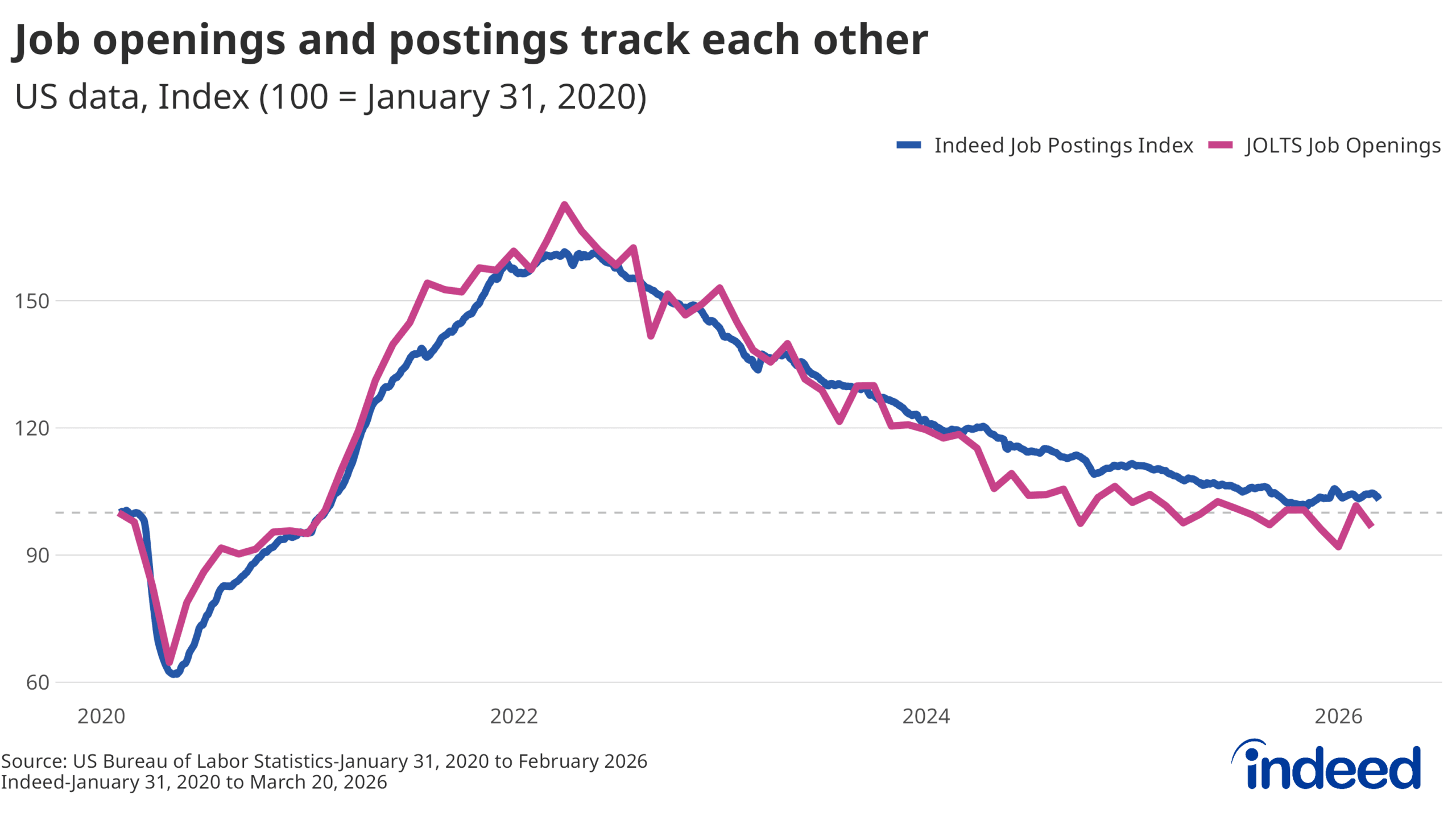
Our approach to data quality goes beyond benchmarking and upstream checks. Our process involves a combination of statistical and economic tests that evaluate any restatements, identify structural breaks in data series from one week to the next, and quantify levels of variation both within and across data series to look for anomalies. And sometimes the most critical quality check is expert human judgment on the product ecosystem and its potential data impacts, something no model can replicate.
Privacy: different data, different considerations
None of this work is possible without trust, and it’s important to understand that the two primary sources of data used in our work – job postings data, and job seeker data – require fundamentally different privacy considerations. Job postings data is public by nature, and meant to be seen; job seeker data is highly personal and unique to each user, and cannot be individually disclosed.
Knowing that, our approach to data privacy is grounded in several key principles:
The power of aggregation: Indeed’s scale means we don’t need to know who you are to understand what the market is doing. We look for patterns across thousands of employers and job seekers, ensuring that no individual journey is ever singled out.
Minimum thresholds and privacy checks: When we analyze smaller segments — say, a niche occupation in a single metro — we apply sample-size thresholds and other privacy checks. If the audience is too small, we aggregate further or don’t publish.
No individual profiling: Hiring Lab’s mission is to understand labor markets and our published work focuses on groups and trends, not individuals. We publish our methodology and benchmark our data against official statistics wherever possible.
Why this matters
Indeed Hiring Lab’s responsibility is twofold: to tell unique and actionable stories about the world of work, and to protect the people behind the data.
The labor market is dynamic and uncertain. Measuring it well in real time, at scale, requires continuous data quality vigilance, careful judgment, operational discipline, and a team that speaks the languages of products, engineering, data science, and economics. We will never stop investing in these methods, tools and safeguards, and will never take our users’ and partners’ hard-won trust for granted.