Hannah Lindsley, Senior Product Director

Introducing Indeed’s Smart Fit Score
February 23, 2026
In today’s employer-driven labor market, hiring teams aren’t struggling to get applications. They’re struggling to identify the right applicants. When dozens or hundreds of resumes hit their inbox, the real challenge is knowing quickly and confidently which applications are actually a fit. That’s exactly why we built the Smart Fit Score™, a core part of Smart Screening, our new ATS integration that screens applicants based on employer’s criteria.
We want recruiting teams to spend less time on manual screening and more on the human side of hiring. A recent Indeed survey* found that hiring managers said using AI screening tools would allow them to spend more time coaching and mentoring their direct reports, have more meaningful conversations with candidates, and ideally, end their workday on time.
Job seekers want this, too. In the same survey, we learned that 71% of job seekers believe AI screening is more efficient and 83% think it makes the entire process faster.
At its core, the Smart Fit Score is simple. It is powered by an employer’s specific screening criteria, which is translated into a structured evaluation framework, weighting each criteria based on what matters most, according to the employer. So if the employer says management experience is a must-have and budgeting experience is a nice-to-have, missing the management experience will have a bigger impact on the score than budgeting experience.
Every application receives a score from 0 to 100 that reflects how well the application aligns with those specific requirements for the role, using only the information collected directly from the job seeker: their resume, screening questions, location details, and more. Smart Screening doesn’t rely on generic benchmarks, third-party data, or comparisons to other candidates. Just a clear, objective measure of fit based on what skills an employer identifies as actually mattering to the job.
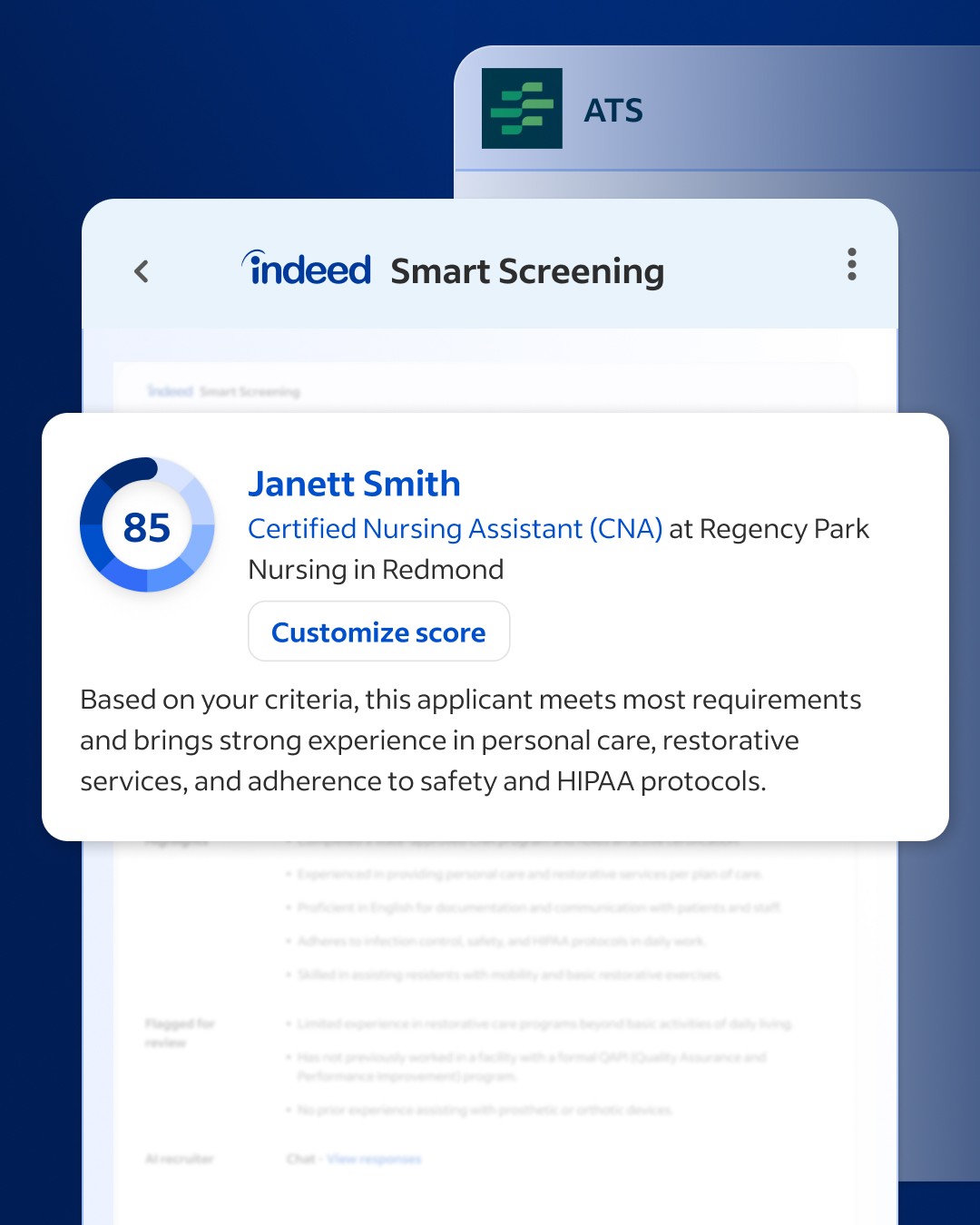
But the number alone doesn’t tell the whole story.
That is where the Candidate Summary Page comes in, which sits alongside every score. It highlights where an application best aligns with the job requirements, and identifies areas worth a closer look.
One of the things I like most about this system is how much control it gives employers. If hiring priorities change, hiring teams don’t need to guess how that will affect candidates. They can update their screening criteria, preview how scores would shift, and compare results side by side before making any decisions on the direction of the role. Every adjustment will rescore applications based on the new criteria.
And while the Smart Fit Score is a powerful metric, it’s intentionally not a final decision-maker. Our survey also found that 61% of job seekers believe a human is still involved when their resumes are screened by AI – and we believe that is how it should be. At its heart, hiring is human. And the combination of technology and human care and judgment will improve the hiring process for everyone.
*This survey was conducted online within the United States by The Harris Poll on behalf of Indeed from December 29 – January 7, 2026 among 1,037 U.S. adults ages 18 and older who have looked for a job within the past 5 years and 214 hiring managers in companies with 1,000+ employees. The sampling precision of Harris online polls is measured by using a Bayesian credible interval. For this study, the sample data is accurate to within + /- 3.0 percentage points for job seekers and +/- 6.6 percentage points for hiring managers using a 95% confidence level.
For complete survey methodology, including weighting variables and subgroup sample sizes, please contact us_pr@indeed.com.