Return-to-Office Resistance? Here’s How to Overcome It

Company leaders say they want employees back in person to boost collaboration and productivity — but they’re meeting resistance from workers who are reluctant to give up the freedom and flexibility of remote work.
Starbucks employees signed an open letter protesting the company’s return-to-office mandate; when Amazon announced its plans, workers started a petition that garnered 30,000 signatures. Other employers have resorted to ultimatums and bribery to boost worker attendance, with Google threatening negative performance reviews and Salesforce offering to match days spent in the office with charitable donations. In companies requiring a five-day-per-week return, most employees simply ignore the mandate (while 40% of managers, in turn, choose to ignore the rule-breakers).
“The reality is, the pandemic forever changed the way we work,” says Priscilla Koranteng, Indeed’s Chief People Officer. “The most successful organizations today are embracing flexibility, and not just implementing return-to-office policies — but also giving people a place that they want to return to.”
“The most successful organizations today are embracing flexibility, and not just implementing return-to-office policies — but also giving people a place that they want to return to.”
Priscilla Koranteng, Indeed’s Chief People Officer
With this in mind, here are four strategies for getting return-to-office buy-in from employees.
Get the latest insights on the workplace and hiring, straight to your inbox
Sign Up Now1. Embrace Hybrid Work
There’s no denying it: hybrid work is emerging as the clear winner for return-to-office policies. According to McKinsey’s State of Organizations 2023 report, 90% of employers have implemented some form of hybrid-work arrangement — and four out of five employees who have engaged in hybrid work in the past two years would like to keep it that way. According to WFH Research, 46% of professionals capable of working from home are in hybrid arrangements, while only 35% are fully on-site and 19% are fully remote.
Going hybrid offers many benefits for companies and their workers, including:
Work Wellbeing
Flexibility is a key driver of work wellbeing. Research shows that employees who choose to work from home exhibit a 13% boost in performance, higher job satisfaction and lower attrition, while new mothers who work at home are less likely to experience depression. In a 2022 Gallup survey, workers listed the top benefits of hybrid work arrangements as better work-life balance, productivity, efficiency and control over where and when they work, with less burnout.
Productivity
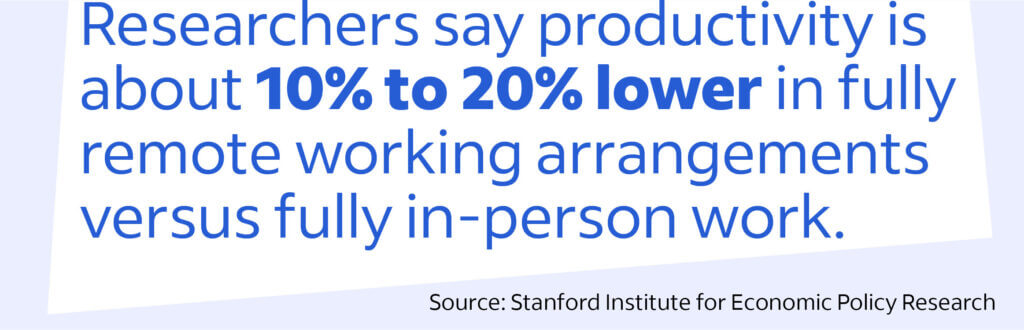
Workers say they’re more efficient when working from home, but managers’ concerns about productivity may not be entirely unfounded: Researchers at the Stanford Institute for Economic Policy Research say productivity is about 10% to 20% lower in fully remote working arrangements versus fully in-person ones. However, they found hybrid work makes no difference in productivity — apart from potentially offering a “mildly positive impact on performance.”
Recruiting and Hiring
Hybrid work policies are also a competitive recruiting tool in the ongoing tight labor market. In a Scoop Technologies Inc. survey of around 3,600 companies, those with flexible work options — including remote, electively remote and hybrid — hired more than two times faster than fully in-office organizations. Adopting a hybrid-first approach to work has enabled the company Autodesk to increase the number of job applications by 58%, including an 82% boost in female-identifying candidates and a 45% increase in candidates from underrepresented groups.
As you create or solidify your hybrid work policies, consider what will strike the ideal balance between productivity and work wellbeing while still offering enough flexibility to give you the competitive edge for talent. Though there are many types of models, many companies are moving toward a structured hybrid approach, generally requiring workers to come in two to three days per week between Tuesday and Thursday.
2. Reimagine Your Workspace
With structured hybrid arrangements, your space may be a virtual ghost town on Mondays and Fridays but experience high traffic on other days. How will you reimagine your office to accommodate new ways of working?
“One of the more important things we discovered during the pandemic is that different people have different needs in order to be the most happy and productive,” says Indeed CEO Chris Hyams in a recent episode of the Indeed podcast Here to Help. “Some people need quiet time, some people need interactions and some people need a combination of the two.”
Indeed, which had shifted to fully remote work during the pandemic, began requiring a portion of its workforce to return to the office at least two days per week in the summer of 2023. The new Indeed Tower global co-headquarters in Austin, Texas, is not only a thoughtfully designed space that encourages community and collaboration but also a flexible, hybrid-first work environment that’s versatile and customizable. It offers a “coffee-shop” workplace experience and promotes hybrid collaboration through features such as wireless-first offerings so workers are free to easily move about the office, updated Zoom technology and movable digital whiteboards. In addition, half of the conference rooms feature flexible partitions, allowing the architecture of the office to adapt as usage needs change.
Yaeji Myung, a workplace innovation manager at Indeed, explains in the episode that what was once considered “hardware” — structures that would take months to renovate — can become “software” that adapts to the fluctuating occupancies of modern offices, like the partitions. “We have the ability to potentially change and bring down those walls, enlarge some conference rooms [or] make them smaller, where we didn’t have that flexibility before,” she says.
3. Double Down on Equity, Inclusivity and Belonging
Though the return-to-office discussion often centers on issues of productivity and work-life balance, these mandates also have an outsized impact on women and historically marginalized groups. For example:
- Women: Returning to the office places a significant burden on women, who traditionally bear the majority of childcare responsibilities, in addition to the demands of new motherhood.
- Workers of color: In a study by Future Forum, only 3% of Black knowledge workers wanted to return to the office, compared to 21% of white knowledge workers, likely due to the daily microaggressions many experience in the physical workplace. Other data shows that both women and people of color say they prefer remote or hybrid work more than white men do.
- Workers with disabilities: Remote-work options open up opportunities to those with accessibility needs that may not be met in a physical office environment.
- LGBTQ+ workers: In an Indeed survey of LGBTQ+ workers, 76% of those working in a hybrid or remote capacity said they feel safer expressing themselves from home versus working in the office.
If you’re asking workers in these groups to return to the physical office, are you also providing them with the support they need to succeed, maintain work wellbeing and feel like they belong in your organization?
This might mean strengthening or expanding the focus of your DEIB program, upgrading accessibility accommodations in your office, or bolstering Employee Resource Groups (ERGs) or Business Resource Groups (BRGs) that provide employees with opportunities to connect with peers and make their voices heard. Consider enhancing your family-friendly benefits as well, including offering paid parental leave, flexible work hours and resources for working parents, such as services that assist with finding quality backup childcare options.
To guide your efforts, conduct employee engagement surveys and focus groups with workers from underrepresented communities to see where you can improve equity, inclusivity and belonging and act upon your findings.
4. Cultivate Connection
For Hyams, the dialogue around the return to office is a classic case of the manager-worker divide — but not in the way you might think. “Managers want people to go back to work because they think they’ll be more productive, but employees actually want to go back for connection,” he recently shared in Fast Company.
“Managers want people to go back to work because they think they’ll be more productive, but employees actually want to go back for connection.”
Chris Hyams, Indeed CEO
No one likes commuting to an office only to sit in Zoom meetings all day, so it’s imperative to intentionally create opportunities for employees to forge bonds, network and connect with one another face to face. As part of a structured hybrid approach, try choosing “anchor days” — usually Tuesday, Wednesday and Thursday — to draw employees back into the office at the same time. Use these common touchpoints to plan company-wide meetings, training opportunities and other group activities. Encourage managers to hold their team meetings, one-on-ones and team lunches on these days as well. The opportunity to make meaningful connections will help ensure that employees value their time spent together in person.
At the end of the day, nothing matches the value of human connection.
“I think that’s what we all realized after being quarantined during the pandemic,” says Myung. “There’s just something about the ability to connect with someone in person that technology hasn’t achieved yet.”
Get the latest insights on the workplace and hiring, straight to your inbox
Sign Up Now
Discover Work Wellbeing
Get insights and inspiration for the modern world of work
We’ll be in touch soon with the insights and inspiration you need to lead a thriving workforce. In the meantime, check out the recommended articles below.


