Why 2027 Will Break the ‘Low-Hire, Low-Fire’ Labor Market

“Something is going to give in 2027.”
That’s the read from Cory Stahle, senior economist at Indeed, on a “low-hire, low-fire” market that has kept workers stagnant and unsatisfied for two years. “Workers ultimately are feeling stuck right now, and with a lot of pent-up resentment,” says Daniel Zhao, chief economist at Glassdoor. With hiring starting to pick up, our economists expect that resentment to surface. For employers, it’s closer than it looks.
Indeed and Glassdoor’s 2027 U.S. Hiring and Worklife Trends Report offers an informed look at where the labor market is heading, drawing on data from Indeed Hiring Lab, Glassdoor company reviews and the latest Workforce Insights Survey. Employers are already feeling the strains of forces fueling those trends, like a thinning leadership pipeline; a younger, under-supported generation moving into management; AI reshaping every role and rewards packages losing ground to inflation.
But employers who see these shifts coming have time to get ahead of them. Here are five shifts to prepare for in 2027.
Get the latest insights on the workplace and hiring, straight to your inbox
Sign Up NowShift 1: Retention risk is silently snowballing
The data at a glance
- Changing jobs is paying off again: According to the Atlanta Fed, workers who switch companies are getting much larger salary increases than those who stay in their current roles, reversing two flat years where moving offered little financial gain.
- Hiring is picking up: Hiring Lab data shows that 49% of metros experienced year-over-year growth in job postings by late 2026, up from just 10% at the start of the year.
- Workers are eyeing the exits: Satisfaction scores and company review sentiment across Glassdoor reveal an overall pent-up desire to quit. Glassdoor reviewers dissatisfied with their career opportunities (rating them 1 or 2 stars out of 5) rose to 21% in September 2026, up from 17% in April 2022. That’s significant because a 1-star decline in career opportunity ratings on Glassdoor is associated with a 28% increase in turnover intent.
- Hiring managers gearing up: Rising job postings and hiring manager sentiment point to a rebound, with anecdotal evidence suggesting that employers are preparing to hire more in the coming months.
What this means for employers
Two years of subdued hiring and firing have lulled organizations into a false sense of stability, but turnover is just one economic shift away.
“Don’t take silence as a sign that people are happy or that they aren’t frustrated,” says Stahle. His team compared worker dissatisfaction with historical patterns and found a gap of roughly a third of a million quits.
“Just imagine what happens when half a million people traditionally would have quit, but haven’t. Now, that all starts to hit at the same time.”
-Cory Stahle, Indeed senior economist
Now is the time to stay attuned to your workforce's needs. “Leaders really need to ask workers what challenges they’re facing in order to actually drive a solution,” Zhao recommends.
Shift 2: The dwindling senior leadership supply
The data at a glance
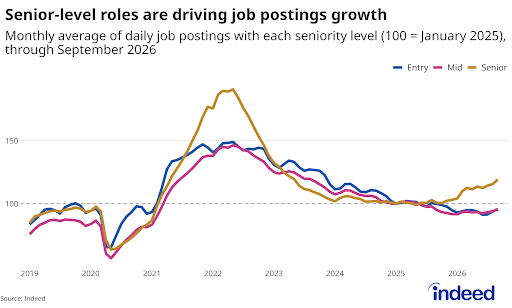
- Employers are prioritizing experience over development: Job posting growth across the Indeed Job Postings Index (JPI) is driven almost entirely by senior positions.
- By September 2026, senior-level job postings were up 19.2% above their January 2025 levels.
- Over that same period, both entry-level and mid-level postings fell by approximately 4%.
- Disproportionate competition: Entry-level postings attract several times as many applications per posting as senior roles. As recently as May, almost half of applications from job seekers with 10+ years of experience went to entry-level postings.
- Entry-level workers are struggling: More than half (50.4%) of 2025 college graduates were underemployed (working in a job that doesn’t require a degree) a year after graduation, and recent grad unemployment climbed 1.3 percentage points to 5.7%.
- The middle is burning out: Reviews on Glassdoor suggest severe burnout among mid-level managers, exacerbated by ongoing layoffs and pressure from leaders to get more done with less. Mid-level workers face a 4% decline in job postings on Indeed and the lowest career satisfaction on Glassdoor, with opportunities rated an average of 3.1 out of 5 stars.
What this means for employers
Facing budget constraints, recruiters have prioritized senior and specialized hires while relying on AI to handle tasks traditionally given to early-career talent. This may unintentionally deliver quick productivity gains now at the expense of leadership pipelines and long-term workforce health.
“If you aren’t going to invest in those entry-level workers today, that is going to create a hollowing out of your talent pool tomorrow,” Zhao says. “I don’t think this is a place where employers get the benefit of picking and choosing which group to focus on more.”
Shift 3: A demographic pivot with Gen Z at the helm
The data at a glance
- A big part of the labor pool: Gen Z makes up 24% of the overall workforce. They’re no longer the entry-level new kids on the block, but core contributors to your organization.
- Gen Z is taking charge: This group also now represents approximately 1 in 8 people managers. If historical trends continue, our economists project this generation will surpass baby boomers in management in 2027 and Gen X in 2033.
- In-person connection matters to them: The Indeed Workforce Insights Survey indicates Gen Z is the cohort least interested in fully remote work (29%) and leads all generations in desiring hybrid work (28%), with 43% actually preferring to be primarily onsite.
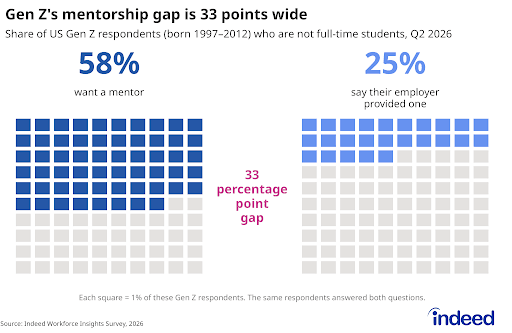
- They want guidance: Nearly 60% of Gen Z employees actively desire a formal mentor, yet only 25% receive one through their employer.
- Rewards look different: When ranking top benefits, they prioritize culture and flexibility while placing less weight on traditional benefits like 401(k)s and dental plans.
What this means for employers
Organizations are facing a critical deficit in leadership enablement that Gen Z wants, which could lead to early burnout and high turnover.
The fix doesn’t have to break the bank. Mentoring is “ultimately a fairly cheap thing to do,” Stahle says. He suggests pairing workers nearing retirement with Gen Z employees. This strategy maintains critical institutional knowledge while fulfilling the demand for guidance and development. And the urgency is very real — “Gen Z workers are on track to become one of the largest groups of people managers in the next five years,” Stahle says, “and they’re going to need mentoring to get there.”
At the same time, reevaluate what you’re offering. If you want to recruit and keep the ambitious young talent that will form the foundation of your future management team, leaning into hands-on career growth and flexibility will do far more than standard corporate benefit packages.
Shift 4: AI as a permanent structural rebalance
The data at a glance
- AI usage is up, but guidance is lacking: According to the Workforce Insights Survey, the share of employed workers using AI at least weekly in their personal lives grew from 44% in 2025 to 53% in 2026, while professional users rose from 36% to 42%. Yet many employers have been slow to integrate it: almost a third (31%) of workers report low-to-zero AI adoption at their workplace.
- Jobs are transforming: Postings in highly AI-exposed sectors continue to buoy the Indeed JPI, indicating job transformation over outright elimination. The share of postings mentioning AI in job descriptions doubled to 7.2% over the past year, but almost two-thirds of those explicitly listing “AI” in the job title are now in roles outside traditional tech occupations.
- Workers are anxious: Public sentiment on Glassdoor regarding AI is increasingly apprehensive. AI mentions in Glassdoor reviews jumped 2.6x year over year, but positive sentiment dropped to 45% (from 82% in 2019).
What this means for employers
“We have seen a strong connection between workers not being happy with leadership and not being happy with AI,” says Stahle. Listening to workers’ concerns and applying AI “in the way that workers feel is helpful is going to go a long way.”
As AI permanently changes the day-to-day functions and core skills required across roles even outside of tech, employers should consider proactively redefining job descriptions and integrating AI literacy into development pathways to keep up.
Shift 5: Health coverage and total rewards erosion
The data at a glance
- Paychecks are under pressure: Advertised pay as measured by the Indeed Wage Tracker slowed down to 2.5% year over year as of September 2026, falling behind an inflation rate of 3.7%. Rising prices are overwhelming wage growth and leaving Americans with less purchasing power than they had at the same point last year.
- Benefits satisfaction is dropping: Glassdoor compensation and benefits ratings have declined steadily since their 2021 peak, driven in part by dissatisfaction with health insurance.
- Healthcare is the deciding factor: Health coverage remains the most important benefit for over a third (34.7%) of workers. Almost 1 in 5 active job seekers cite better benefits as a top reason for looking for a new role, second only to higher pay.
- Flexibility is key: Low-cost levers remain within workers' top five priorities. The Workforce Insights Survey found the top non-monetary motivators to be:
- Flexibility to work from home: 13%
- Flexible hours: 11%
- Role aligns with my values: 10%
- Better work-life balance: 8%
What this means for employers
Your employees are increasingly evaluating their compensation through the lens of security. Quality health coverage and lifestyle flexibility can help offset the lack of broad pay raises, but they don’t solve everything. “You can’t necessarily feed your family with your health insurance card,” Stahle says.
Some employers may omit retirement from their postings, or specific plan options like HSAs or high-deductible plans, even when they provide them. “The lowest-hanging fruit is to make sure you’re advertising everything you have to job seekers,” Stahle advises. Regardless of what you offer, what matters is a package intentionally designed for the conditions your workforce is living in.
What should employers do now to get ahead of 2027 hiring and retention risks?
The data reveals that people stay where they see a future, feel supported and believe their rewards reflect their worth. To stay ahead, find out whether your retention is built on commitment or caution, rebuild your leadership bench, give employees a clear plan for AI and design total rewards for the pressures your people face today.
The main goal is ensuring your workplace delivers the security your people want. Stahle puts it simply: “Make sure you’ve got the fundamentals taken care of before you start trying to do anything too fancy.” That’s what will set companies apart in 2027.
Get the latest insights on the workplace and hiring, straight to your inbox
Sign Up Now
Discover Work Wellbeing
Get insights and inspiration for the modern world of work
We’ll be in touch soon with the insights and inspiration you need to lead a thriving workforce. In the meantime, check out the recommended articles below.

