Editor's note: This piece was originally published in July 2020 and has been updated to reflect data in 2024.
In today’s turbulent business landscape — from ongoing apprehension about a recession to ongoing hiring and retention challenges — leading with emotional intelligence (EI) is more important than ever before.
Research shows that EI among managers not only positively impacts project success while mitigating conflict but also increases employee job satisfaction and trust. A recent report from the Workforce Institute at UKG even found that managers have an outsized influence on employee mental health — greater than that of therapists or medical professionals and equal to that of spouses. In addition, Indeed’s US Work Wellbeing 2023 Report shows that manager support is one of the key drivers of work wellbeing — a proven indicator of business success and a major demand for job seekers and employees alike.
“Managers play a significant part in all elements of work wellbeing,” says Janeane Tolomeo, Indeed’s Work Wellbeing Initiative lead. “That’s because managers create the conditions for their team members to thrive — if they know what their people need. That's where emotional intelligence plays a really big role.”
Get the latest insights on the workplace and hiring, straight to your inbox
Sign Up NowBut What Is Emotional Intelligence for Workplace Leaders?
You’ve likely seen or heard of EI or how it’s measured — emotional quotient (EQ) — but what does it actually refer to? Author and psychologist Daniel Goleman popularized the concept of EI in his 1995 bestseller “Emotional Intelligence: Why It Can Matter More Than IQ.” In it, he defines EI as “the ability to recognize, understand and manage our own emotions as well as to recognize, understand and influence the emotions of others.”
Goleman describes EI in four quadrants as follows:
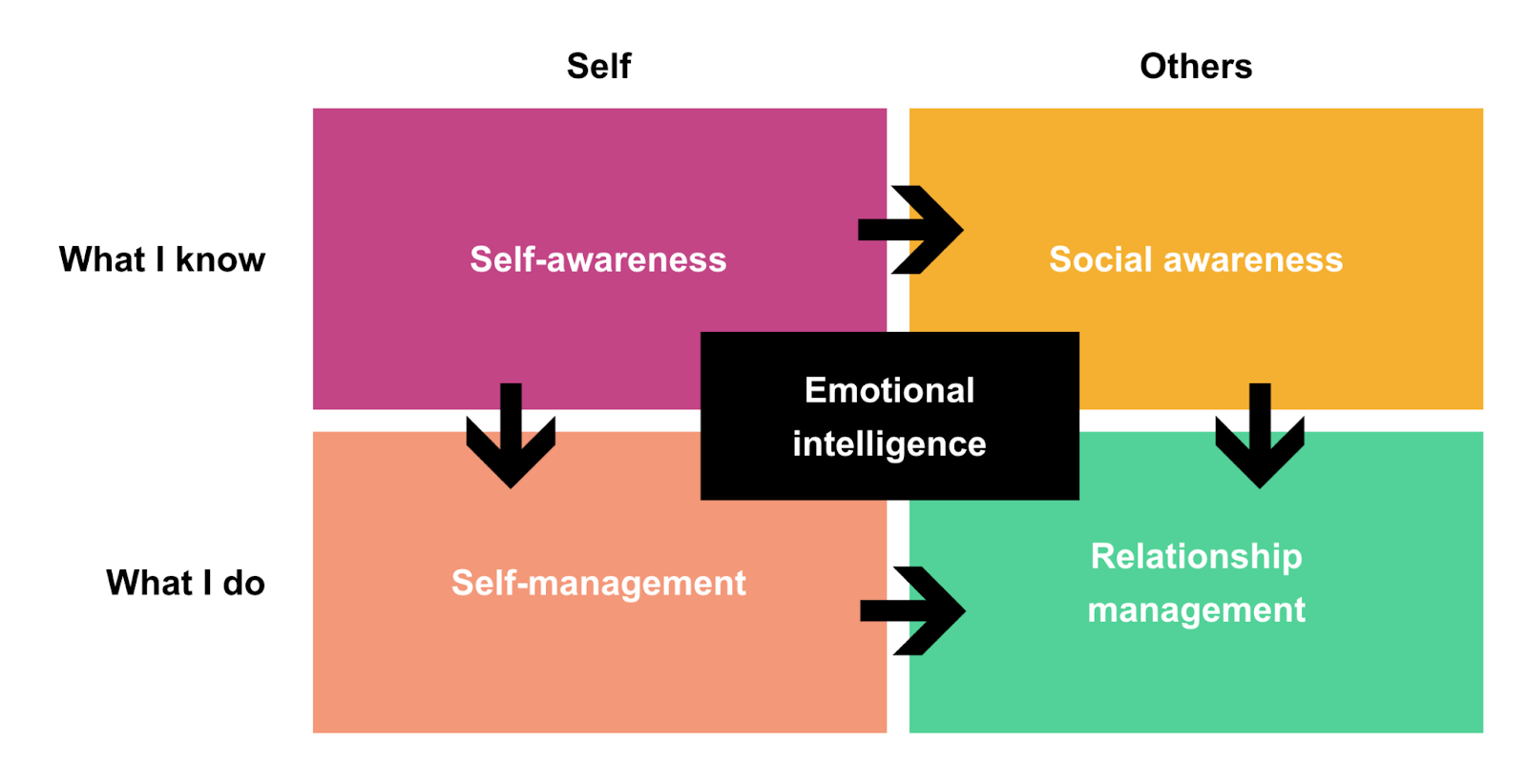
Here’s how to hone your skills in the four pillars of EI, as well as the 12 competencies within them, in order to lead more resilient, thriving teams.
Be Aware of Your Own Emotions and Values
The first quadrant of EI is self-awareness, which involves the element of “emotional self-awareness,” or recognizing your emotions and their impact, and realizing your strengths and limitations.
In addition to being honest with yourself about how you’re feeling, reflect on your most important values. Even if you’ve done this exercise before, make a point to periodically reevaluate what’s important to you. Think about your core values. Have they evolved over time? Which ones resonate most right now? Write them down to help you recall what matters most to you. If you’re feeling overwhelmed, your core values can be a benchmark to help you prioritize how to best focus your time and energy.
Practice Mindfulness When Dealing With Strong Emotions
The second quadrant of EI is self-management, which includes emotional self-control, adaptability, achievement orientation (or a focus on achieving excellence) and maintaining a positive outlook. To build your mastery of self-management, start by striving to cultivate positive reactions when faced with strong emotional triggers.
Think about a time you experienced an overwhelming emotion — for example, maybe you received harsh feedback from a colleague or direct report that made you feel angry and hurt. The next time you find yourself in a similar situation, pause and take a moment to identify how you feel. Simply recognizing the emotion can bring you into the present moment and help you begin to process it.
Once you’ve identified the emotion, take a few deep breaths to reset — you’ll feel more calm and clear-headed as you decide how to respond. While this may sound simple enough, it takes practice and discipline to manage strong emotional reactions, especially during uncertain times.
Connect With Your Team on a Human Level
The third quadrant of EI, social awareness, involves both empathy and organizational awareness. It’s how you approach interpersonal relationships, such as your ability to pick up on social cues and recognize the emotions of others, as well as how well you understand the human dynamics of your organization. In other words, social awareness allows managers to successfully read the room and support their employees accordingly.
But you don’t have to be a mind reader to practice social awareness. Simple questions like “How are you doing?” and “How can I help?” can be powerful tools for building trust and improving work wellbeing on your team. Having open and honest conversations is also valuable for cultivating a sense of inclusion and belonging in a hybrid work environment.
“Do you feel comfortable asking your team how they're feeling, even if the answer might not be positive that day?” Tolomeo asks. “Are you willing to open the door for that conversation and create space? It’s so important for people to have trust in their managers so they can share how they're actually doing and what they need.”
Leverage EI to Inspire Growth, Teamwork and Positive Change
The fourth pillar of EI is relationship management, or the ability to influence, coach and mentor; negotiate conflict; encourage teamwork and inspire others. Those skilled in relationship management may be especially adept at encouraging employee growth and development, bringing diverse teams together, mediating conflicts and being a catalyst for change — essentially, what every leader is tasked with accomplishing.
However, this final competency is the culmination of the first three EI elements, so there’s no quick fix or simple tip for improving your relationship management abilities. Only by first mastering self-awareness, self-management and social awareness can you build the foundation for a more successful, emotionally intelligent leadership approach.
Was this article helpful? Do you have ideas for future stories? Please email leadwithindeed@indeed.com and tell us what you think. Thank you!
Get the latest insights on the workplace and hiring, straight to your inbox
Sign Up Now
Discover Work Wellbeing
Get insights and inspiration for the modern world of work
We’ll be in touch soon with the insights and inspiration you need to lead a thriving workforce. In the meantime, check out the recommended articles below.


