Fake Resumes, Real Risks: How Tech Employers Can Prevent Fraud

Key Takeaways
- Employers are reporting more fraudulent or unqualified applicants than ever — particularly with tech talent — partially due to the reduction in entry-level jobs.
- Some companies have thwarted fraud by requiring cameras on at all times, deploying local employees to verify identities and leveraging AI.
- Signals of dishonesty can include repeating interview questions to feed them to AI or referring to team actions over personal contributions.
Data from the latest Indeed Tech Talent Report reveals a striking paradox: Entry-level tech talent is the most active group in the market, yet fewer openings are available to them. As Linsey Fagan, Indeed Global Client Strategist, explains, “That talent still needs a job, regardless of what’s posted. So they’re applying to roles they’re not a fit for, contributing to the flood of unqualified applicants.”
The problem of fraudulent applicants has been an ongoing plague on the tech industry, but it’s compounded by the recent surge of unemployed graduates. Employers are inundated with resumes, making it harder to stay vigilant against fraud. Meanwhile, the pressure to fill roles quickly can lead to costly mistakes, especially in highly regulated sectors such as fintech, where a single fraudulent hire can have severe legal and reputational consequences.
At Indeed FutureWorks 2025, Fagan facilitated discussions among employers on how to identify fraud and validate skills in ethical ways. Here’s what they came up with.

Indeed Global Client Strategist Linsey Fagan led several hands-on sessions about the shifting landscape of tech talent, helping leaders think differently to build a more agile approach.
Get the latest insights on the workplace and hiring, straight to your inbox
Sign Up NowThe Many Faces of Fraud in Tech Hiring
Fraudulent applicants in tech aren’t new, but the tactics are becoming increasingly varied and difficult to detect. As Fagan notes, “It’s a long-term challenge and one of the largest pain points that employers hiring tech talent come to us with.”
The forms of fraud range from embellishing or fabricating experience and degrees to inventing entire work histories or educational backgrounds. In some cases, candidates have managed to remain in a job for years, relying on colleagues to cover for their lack of expertise. Fagan also explained how the remote-work boom during COVID-19 added a new twist: Some individuals outsourced their work to others, which employers only discovered when requiring them to appear on camera.
“There isn’t an ethical reason for doing this,” Fagan says. “Some people need experience to get a job but can’t get the job without experience. Still, there are many platforms to upskill instead of lying on a resume.”
| 💡Help us shape the future of work. After exploring our thought leadership content, please take our quick 3-minute survey. Your feedback will help us create resources that truly serve your needs. |
Red Flags: What to Watch For
Fagan offers practical advice for spotting potential fraud:
- Robotic resumes: Many fraudulent resumes have a distinct, unnaturally polished style, which often signals an overreliance on AI-generated writing.
- Avoiding the camera: Reluctance to turn on the camera during interviews can indicate dishonesty.
- Repeating answers: Candidates who repeat questions or appear to be reading from a screen may be using AI to generate answers in real time.
- Vague or team-focused answers: Watch for candidates whose responses rely on what “the team” did, rather than their individual role.
Employer Strategies: What’s Working
At Indeed FutureWorks 2025, employers and experts shared tactics that have been successful in the fight against fraud.
1. Local in-person interviews for remote roles
Some companies require remote applicants to meet with any employee in their area for an interview. This helps verify the candidate’s identity and location while saving on time and travel costs.
2. References at application
One employer found that asking for references up front significantly reduced the number of applications. “People won’t supply references if they haven’t done the work,” Fagan points out.
3. Cameras on — always
Requiring candidates to keep their cameras on during interviews is an easy but effective way to deter fraud. In some cases, employers have even asked candidates to stand up and rotate their laptops to show their surroundings and ensure no one else is present.
4. Proctored assessments and eye tracking
“If you’re not proctoring assessments, you need to invest in good ones. They can be very effective,” Fagan recommends, and technology is playing a growing role. Employers are turning to tools that prevent candidates from opening other windows during tests and conduct eye gaze tracking. These solutions help ensure that the person taking the assessment actually has the skills to do the job.
5. AI screening
AI screening can help reduce bot applications. Take Indeed Smart Screening, for example: “One of the biggest concerns employers raised at FutureWorks was the rise in false resumes and fraudulent applicants,” says Hannah Lindsley, Indeed Senior Director of Data Science. “In response, we’re expanding document-upload abilities in Advanced Screening next year to cover diplomas and certifications. This helps ensure employers can trust the qualifications they see.”
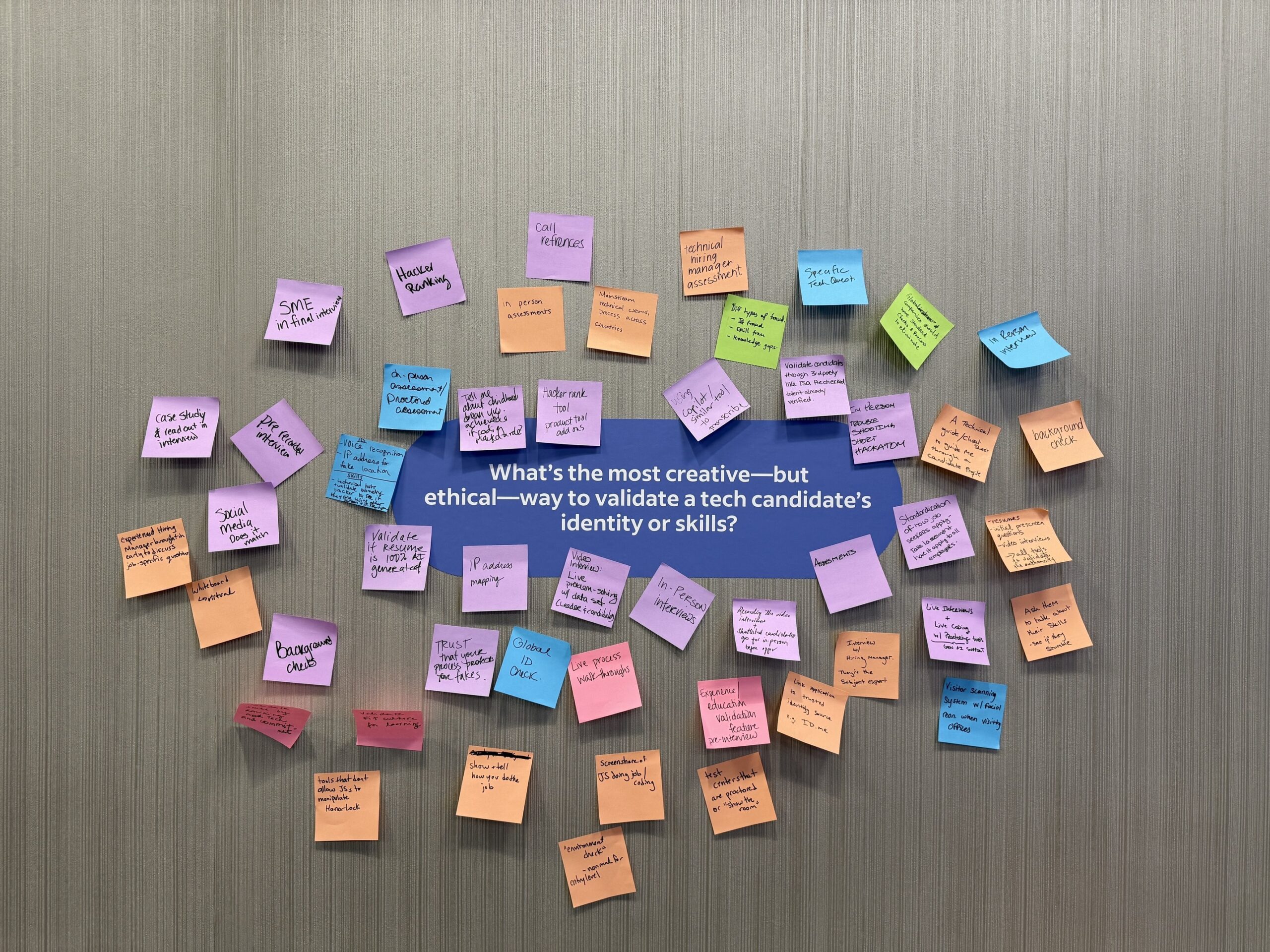
At FutureWorks 2025, employers shared strategies to verify applicants’ skills, like screensharing while coding, checking a candidate’s social media and mapping IP addresses.
From Fake Applicants to Fake Offers: Staying Vigilant Together
Employers aren’t the only ones dealing with deceit in hiring. Unfortunately, fraudsters are exploiting the job market slowdown by impersonating recruiters and offering job seekers fake opportunities.
These deceptive parties aim to steal information or money. They use generic emails or unknown numbers to send unsolicited, vague offers that seem too good to be true. Our Newsroom has more tips on how to spot and avoid job offer scams.
Times may feel stressful when canvassing the job or candidate trenches. Ultimately, job seekers can prioritize their safety, and employers their businesses’ integrity, by recognizing these red flags and trusting their instincts when something feels off.
To learn more about the current tech talent landscape, check out Indeed’s latest Tech Talent Report.
Indeed provides this information as a courtesy to users of this site. Please note that we are not your recruiting or legal advisor, we are not responsible for the content of your job descriptions, and none of the information provided herein guarantees performance.
_____
Related Links
Indeed Survey: Why Hiring for High-Salary Roles Takes Longer — and What Employers Can Do to Fix It
How to Hire — and Keep — High-Salary Workers in Today’s Market
From Skills Searches to Job Offers: Bridging the Biggest Disconnects That Make Hiring Harder
Get the latest insights on the workplace and hiring, straight to your inbox
Sign Up Now
Discover Work Wellbeing
Get insights and inspiration for the modern world of work
We’ll be in touch soon with the insights and inspiration you need to lead a thriving workforce. In the meantime, check out the recommended articles below.


