What Adam Grant Got Wrong About the Future of Work — and What You’re Probably Getting Wrong, Too

Get the latest insights on the workplace and hiring, straight to your inbox
Sign Up NowKey Takeaways
- Adam Grant admits he was wrong about AI’s emotional intelligence, which should be a huge wake-up call for leaders.
- Leaders need to face the data, even when it’s uncomfortable or counters their beliefs, and rethink how technology impacts human connection in the workplace.
- Your hiring and onboarding are probably broken — and costing you top talent. Instead of clinging to “best practices,” embrace continually “better practices” to thrive in a volatile world.
Adam Grant isn’t afraid to follow the data — even when it proves him wrong.
Last year, the renowned organizational psychologist and author said he was confident that AI wouldn’t catch up to certain human skills, particularly empathy.
But then the empirical evidence came in: Studies showed that regardless of whether someone is getting a chat response from a doctor, a therapist or a date, they can’t tell whether it’s a human or AI. In fact, they feel “more supported, more seen, more cared about” when chatting with AI, as Grant said at Indeed FutureWorks 2025 in New Orleans.
That’s an uncomfortable and contradictory truth; most of us say we prefer talking to humans. But it has been proven by the evidence.
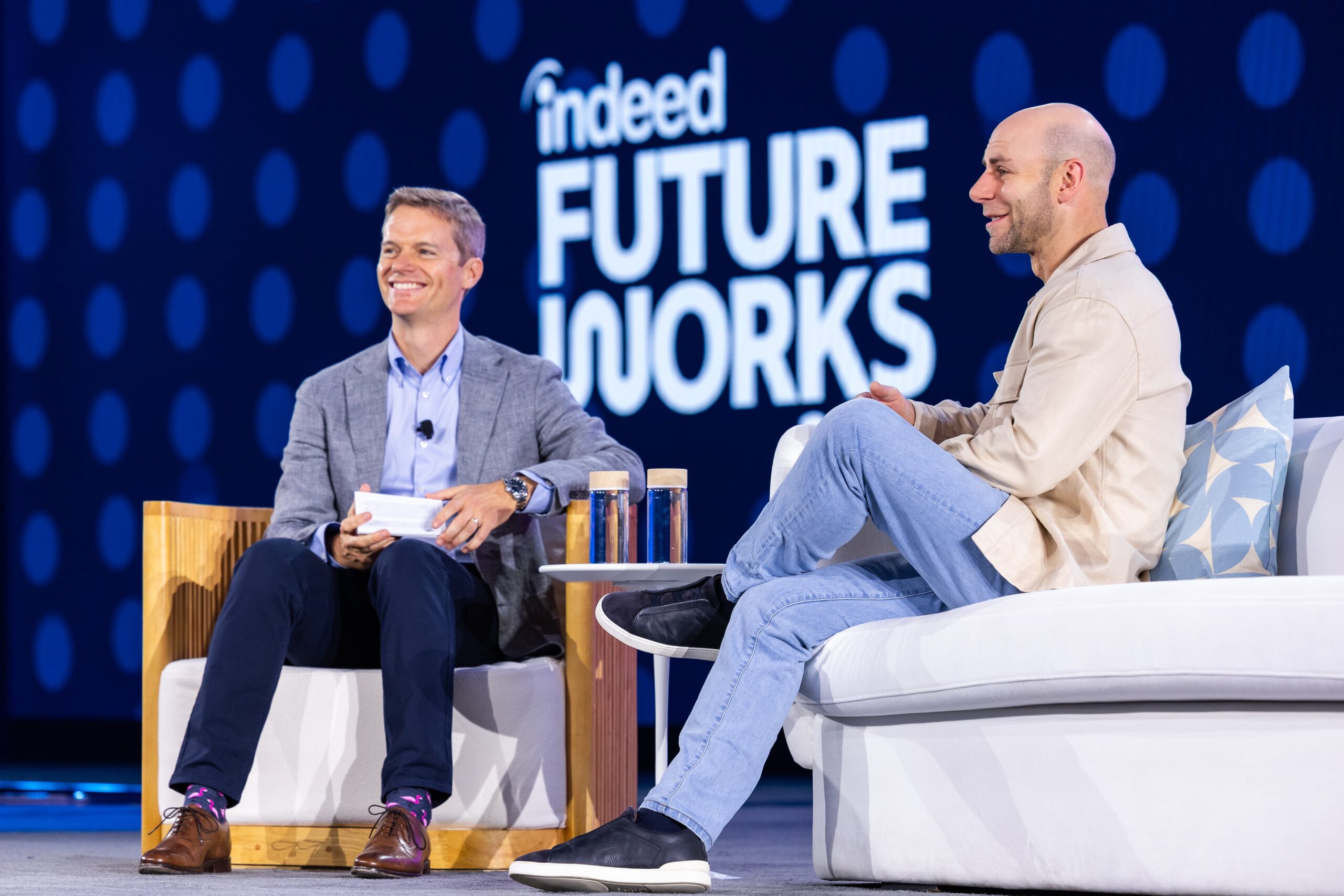
“Now, the good news is that if you tell them it came from AI, they don’t like it anymore,” Grant said to laughter from the crowd. Grant took the stage with Glassdoor President Owen Humphries to discuss this and other counterintuitive data, tensions and misconceptions shaking up — and shaping — the workplace.
Trick questions in job interviews reveal more about the interviewer than the interviewee.
Some interviewers love brainteasers about how many golf balls you can fit inside a jumbo jet … but those trick questions tell you nothing about a candidate, Grant said. “But it does reveal which interviewers are narcissists and sadists,” he said. “That’s not a joke! Believe it or not, there’s empirical evidence on this. The managers who like to throw those questions at you are the ones who like to see people squirm.”
Instead, Grant encouraged different, creative ways to evaluate important human skills. For example, at a GE aircraft engine plant, leaders faced a dilemma: how to hire mechanics who were not only technically skilled but also collaborative. They held group interviews, asking candidates to build a Lego helicopter together. Assessors observed who hoarded pieces and who worked as a team.
“They want to hire the ones who make the group successful,” Grant said, “who [...] don’t care about being the smartest person in the room, [but] want to make the room smarter.”
Every interviewee deserves a redo.
According to Grant, new data from the U.S. Army shows that when job applicants get a second chance to interview, their progress since the first one is a better forecast of their potential than how they did in the first interview.
“So I think everybody should get a do-over,” Grant said.
He experienced a similar situation firsthand. Early in his career, Grant had a job hiring salespeople. He came across a resume that seemed all wrong: a math major who built robots in his spare time. Sure enough, the candidate bombed in the interview.
Later, Grant met with the company’s president. “I explained that this guy was so bad, so unfit for sales — he didn’t even make eye contact,” Grant said. “Our president looked at me and said, ‘You realize this is a phone sales job, right?’”
So Grant brought the interviewee back and, as an exercise, told him to sell him a rotten apple. The guy dazzled him: This wasn’t a rotten apple, it was aged and antique, full of nutrients. You could plant the seeds and get countless more apples.
“I hired him,” Grant said. “And he was the best salesperson in our entire company.”
Being honest about your culture problems during job interviews pays off.
Beware the honeymoon-hangover effect of a new job. “People get recruited with a very rosy picture of the job and the culture that they’re joining, and then they find out a couple weeks later, this is a job, and this is a company, and it’s not as fun and as exciting as I thought it was going to be,” Grant said. As a result, job satisfaction and engagement drop, people risk burnout and are more likely to leave.
Grant said it’s helpful to give interviewers some freedom to be transparent about the job’s shortcomings, as well as challenges in the company culture. “There may be a slight risk when it comes to recruiting and yield goes down, but retention goes up,” Grant said.
You’re getting onboarding wrong.
“The way we bring people into organizations is embarrassing,” Grant said. “The fact that we had to tell Silicon Valley it’s a good idea for a manager to meet their new hire the first day? Is that the best we can do here?”
New hires typically onboard by learning about the job or organizational values, but that doesn’t improve performance or retention, Grant said.
"What I love most about this is that Adam is literally providing sound bites for HR leaders to use in their business-case discussions with their C-suite opposition," one virtual attendee said in the chat during Grant's session.
Research by Dan Cable, Professor of Organizational Behavior at London Business School, uncovered a different, more powerful approach to onboarding that cut quit rates significantly. The method? Asking people to share their personal highlight reel.
“[Think] about your career, the best moments, your proudest teaching. Tell us what that looks like and share that with your new manager and your new team,” Grant said. Then companies know how to tap into candidates’ strengths, and new hires feel “confident from day one.”
“Quiet cracking” is just another name for burnout — and your culture carriers are at risk.
Recent Glassdoor data shows that discussions of burnout are spiking among employees as businesses trim budgets and headcounts. “Many leaders are oblivious to this, in part because they have not created the psychological safety for people to talk about the emotional exhaustion they’re facing,” Grant said. Though some people have dubbed this “quiet cracking,” Grant said it’s just a new term for the same old problem: burnout.
“If you look at who is at greatest risk for burnout, [it’s] culture carriers” who represent company values, he said. “Culture carriers are basically doing two jobs. They have to do their work, but they also are spending tremendous amounts of time [...] telling stories about the culture, being real defenders and champions.” The first step to keeping those individuals is asking other employees to identify them. “You will hear a bunch of the same names over and over,” he said. “And then we need to protect those people. We need to elevate those people.”
“Better practices” beat best practices.
“We live in a world where the pace of change is accelerating, and many of our best practices were built in a world that no longer exists,” Grant said. “They may be obsolete, and we don’t realize it.”
His solution? Look to better practices, not best practices, to be more open to improvement and new research.
Grant recalled working on a project at Google alongside then-CEO Larry Page. When he asked about Page’s biggest fear for Google, Page said that he didn’t want Google to become a “cultural museum.” He worried that “we’re going to take the artifacts and the practices of the past and we’re going to put them in a glass case and admire them,” Grant recalled. “And [Page] said, ‘We have to smash the glass case. We have to break the artifacts and build new practices.’”
We live in unprecedented times, but smart leaders know the world is always changing — and that work needs to as well.
Indeed provides this information as a courtesy to users of this site. Please note that we are not your recruiting or legal advisor, we are not responsible for the content of your job descriptions, and none of the information provided herein guarantees performance.
More Stories From Indeed FutureWorks 2025
Indeed Reimagines Hiring, Using AI to Help Employers Find Quality Talent Faster
Indeed’s New AI Hiring Solutions: First Reactions
40% of Employees Don’t Trust People in Their Company. Now What?
Beyond the Headlines: What the Data Really Says About the Labor Market
Introducing a New Indeed AI Platform to Transform Workforce Management
Get the latest insights on the workplace and hiring, straight to your inbox
Sign Up Now
Discover Work Wellbeing
Get insights and inspiration for the modern world of work
We’ll be in touch soon with the insights and inspiration you need to lead a thriving workforce. In the meantime, check out the recommended articles below.


