Beyond the Headlines: What the Data Really Says About the Labor Market

Key Takeaways
- Despite recession fears, the labor market is stagnating rather than collapsing.
- AI-related job postings are still rare, coming from just a tiny share of employers.
- A labor shortage is looming, making it critical for employers to challenge their “hiring playbook” and embrace AI to augment employees.
Employers and job seekers have endless questions about today’s labor market: Are we in a recession? Is a labor shortage coming? What about the impact of AI on jobs?
Few people are better equipped to answer those questions than Svenja Gudell, Indeed’s Chief Economist.
By analyzing Indeed’s trove of millions of job postings and billions of annual job searches, Gudell can see past today’s chaotic headlines — not just into where the hiring market stands now, but where it’s going.
The good news? “We’re not yet in a recession,” Gudell said during her remarks at the Indeed FutureWorks 2025 conference. The bad: Warning signs are all around us. Gudell leaned on Indeed data to answer some of the most pressing questions about today’s labor market and offer tips for how employers can respond.
“We’re not yet in a recession, but there are some warning signs.”
-Svenja Gudell, Indeed Chief Economist
Get the latest insights on the workplace and hiring, straight to your inbox
Sign Up NowAre We in a Recession?
- Not quite. The labor market has cooled considerably, but unemployment currently stands at 4.3% and layoffs are low. “That’s really some good news,” Gudell said.
- But there are signs of trouble: Inflation is beginning to outpace wage growth, hiring rates are stuck at roughly 2013 levels, and the ratio of job openings to unemployed workers has steadily decreased from 2:1 to 1:1, drastically limiting job seekers’ options.
- That means it takes job seekers four weeks longer, on average, to find a new job than it did two years ago, Gudell said.
- This is partially because quit rates are down, meaning people are holding on to their jobs longer, reducing the churn that happens in healthy markets.
- While it might not be a recession, Gudell said, “We like to call this a frozen labor market.”
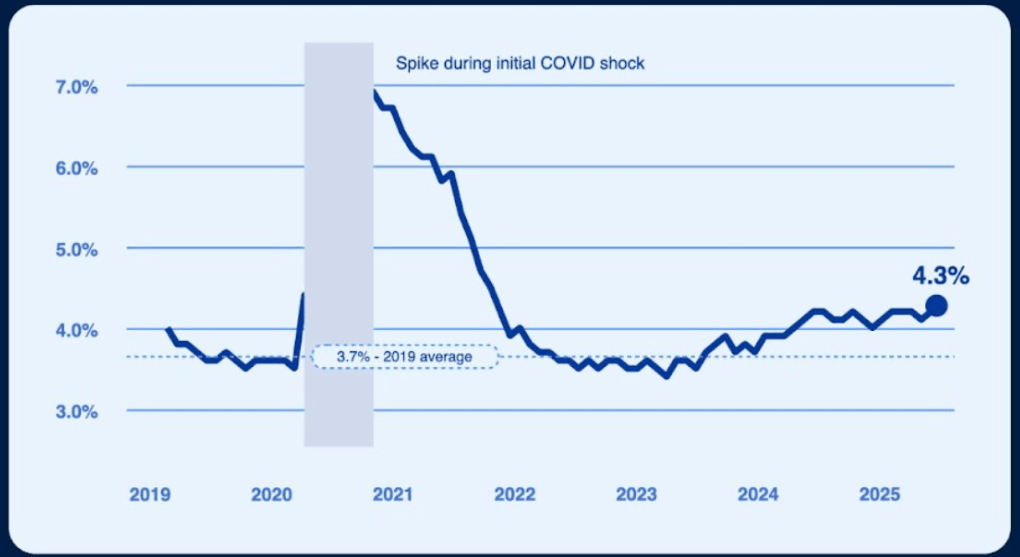
Unemployment remains historically low. U.S. data, unemployment as a percentage of the labor force from January 2019 to July 2025. Source: U.S. Bureau of Labor Statistics.
Are Labor Shortages on the Horizon?
- In short, yes. “Talent shortages are coming, and they’re coming soon,” Gudell said.
- Baby boomers are aging into retirement, she noted, and younger generations are smaller, meaning they won’t be able to match the labor force participation of older generations. Gudell predicts tangible impacts on the labor market as soon as 2027.
- “This is a very huge problem that we’re going to see,” Gudell said.
Chief Economist Svenja Gudell breaks down how slowing growth, shifting labor markets, and demographic changes are reshaping work — and how data can help businesses adapt, build resilience, and plan for the future.
Can AI Fill the Gaps?
- It’s complicated. AI job postings still represent less than 3% of all jobs on Indeed. That’s more than last year, but widespread adoption of AI in job roles is still in its early days.
- Indeed data shows that 95% of employers have no AI job postings at all. In fact, just 1% of companies account for 90% of AI-related postings.
- That doesn’t mean AI isn’t having any impact on hiring. Indeed Hiring Lab recently analyzed nearly 3,000 skills to assess their exposure to AI. The result? While there weren’t any jobs that are fully replaceable by AI just yet, Gudell said, “There’s not a single job that doesn’t have some sort of impact from AI.”
- In the tech industry in particular, Gudell noted, Indeed is beginning to see more postings for senior roles than junior roles. “As AI is able to take over some routine tasks, like basic coding, hiring a more junior person is not as top of mind as it used to be,” Gudell said.
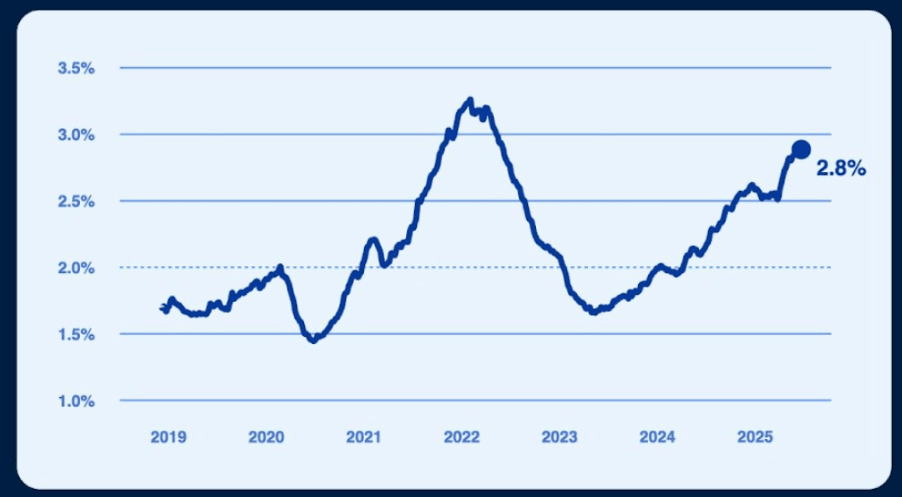
AI mentions are rising, but still remain lower than its peak in 2022. Data reflects AI jobs as a share of all U.S. job postings from January 2019 to June 2025. Source: Indeed.
What Now?
Gudell offered some pointers to help employers adapt to this uncertain and tumultuous market:
- Data is your compass. Indeed’s Hiring Lab data can help talent acquisition leaders benchmark, forecast and optimize their hiring based on real-time labor market trends.
- Flexibility wins: Be prepared to challenge your “hiring playbook” and evolve with the market.
- Use AI as an opportunity multiplier: Focus on building teams that can use and supervise AI effectively — not to replace employees, but to augment them.
Indeed provides this information as a courtesy to users of this site. Please note that we are not your recruiting or legal advisor, we are not responsible for the content of your job descriptions, and none of the information provided herein guarantees performance.
More Stories From Indeed FutureWorks 2025
Indeed Reimagines Hiring, Using AI to Help Employers Find Quality Talent Faster
Indeed’s New AI Hiring Solutions: First Reactions
40% of Employees Don’t Trust People in Their Company. Now What?
Beyond the Headlines: What the Data Really Says About the Labor Market
Introducing a New Indeed AI Platform to Transform Workforce Management
What Adam Grant Got Wrong About the Future of Work — and What You’re Probably Getting Wrong, Too
Get the latest insights on the workplace and hiring, straight to your inbox
Sign Up Now
Discover Work Wellbeing
Get insights and inspiration for the modern world of work
We’ll be in touch soon with the insights and inspiration you need to lead a thriving workforce. In the meantime, check out the recommended articles below.


