Job Description Best Practices
Optimize your new and existing job descriptions to reach more candidates
Get the Guide
What does “flagged” mean on Indeed?
If a job post is “flagged” on Indeed, this means that it’s either been reported by users or detected as potentially violating Indeed’s policies. This could happen for several reasons, such as misleading information, spam, inappropriate content or other Indeed guideline breaches.
Since Indeed aims to create the best possible experience for job seekers, we have specific standards for job posts to ensure they’re safe and relevant opportunities. Jobs that fail to meet these standards might be subject to review and may require additional information.
A job may also be removed from job seeker search results altogether if:
- It’s misleading
- It compromises the job seeker’s experience
- Indeed is not convinced it’s a real job
Please note: Indeed may reject or remove any job and may disable any company’s account, for any or no reason. It cannot give every reason why a job or a company may be removed and retains the right to remove any job, organic or sponsored, if it feels it is in its or its users’ interest.
If Indeed has flagged or removed your post, you may be notified in one of the following ways:
In-post notification: You may receive a message while posting the job that highlights the issue and provides you with steps to resolve it. For example: “It looks like this job post includes a request for applicants to be non-smokers, which violates our guidelines. Please edit your job; otherwise, it may not be posted on Indeed.”
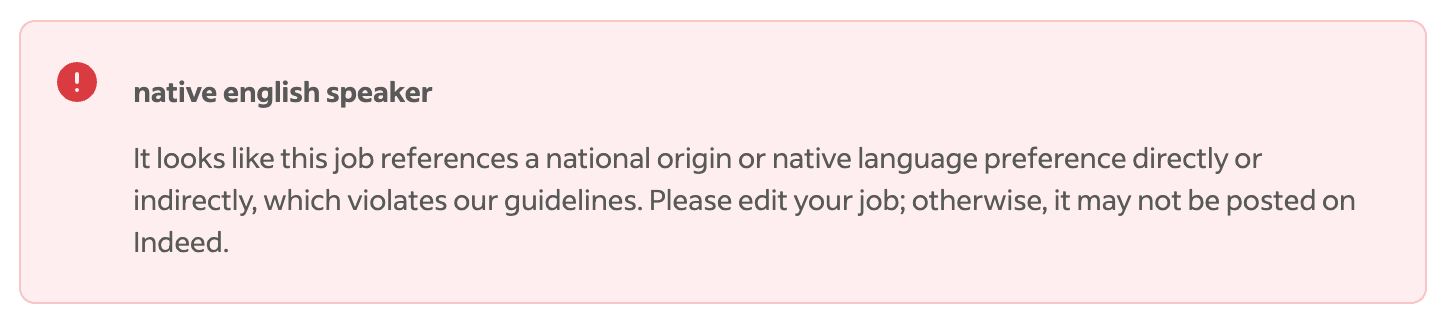
Dashboard notification: You may see a notification on your Jobs page telling you that your job is flagged. You may be prompted to learn more or edit the job.
Email notification: Indeed may send you an email detailing how your post violated its policies and providing you with next steps.
How does a job get flagged on Indeed?
Jobs can be flagged on Indeed in two different ways, either by Indeed’s Trust & Safety team or by job seekers.
Indeed’s Trust & Safety team follows policies and procedures to detect and remove jobs that don’t meet Indeed’s posting requirements, while job seekers can report jobs they come across during their job search.
Why is my job posting flagged on Indeed?
Indeed enforces strict content guidelines for postings so that we can maintain a positive experience for job seekers, with the foundational goal to ensure that all job posts:
- Are transparent and accessible
- Provide clear and relevant information
- Respect candidate privacy
- Maintain a professional tone
If your job does not meet these standards, it may be flagged for review or removal. There are several possible reasons a post might not meet Indeed’s standards, and they’re often related to either the content or how the post was submitted or managed.
Your job post may be flagged on Indeed due to the content you post
Your job might be flagged due to its content, which can happen if you do not provide clear, accurate and truthful information in your post.
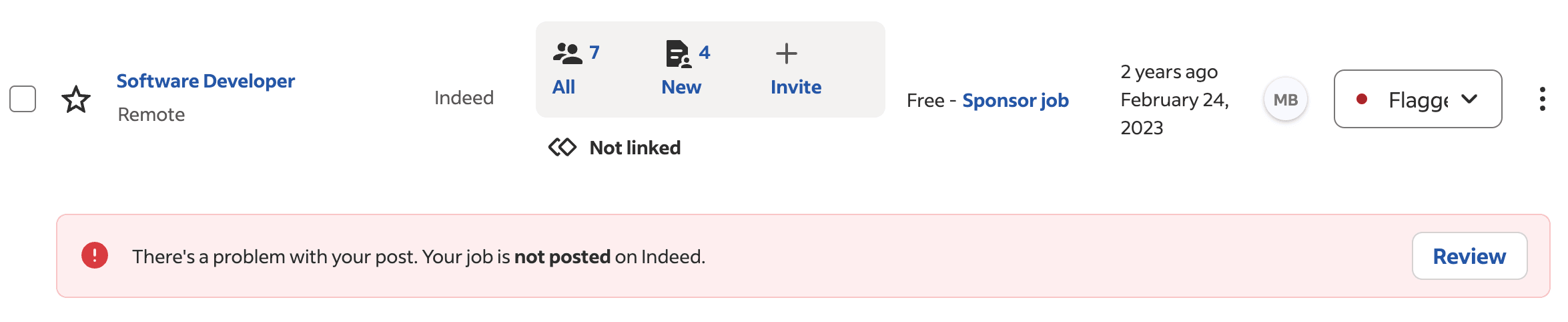
Here are a few examples of why a job may get flagged due to its content:
Low-quality job titles
Job titles that are vague, misleading or overly generic, or that do not clearly reflect the actual role and responsibilities, may be treated as low quality on Indeed. This can include titles that lean on buzzwords instead of describing the work, combine multiple roles in a confusing way or exaggerate seniority. Clear, accurate job titles make it easier for job seekers to find relevant roles and help your post show up in the right searches.
Low-quality job description
Job descriptions that lack relevant details or clarity about the role may be considered low-quality. This includes descriptions that appear spammy or unprofessional (i.e., using excessive punctuation or informal/unprofessional language).
Job descriptions that repeat the same words or phrases unnaturally, just to show up in more searches, can be treated as keyword stuffing and may cause your job post to be flagged. If you’re unsure how to phrase things or want help tightening your content, you can use our AI Job Description Generator to create a clear draft you can edit.
Offensive content
Indeed is committed to providing a safe, respectful experience for job seekers, so any offensive content must be excluded from job postings. This includes slurs or insulting language, harassing or threatening statements, sexually explicit or vulgar content, and any wording that demeans or targets people based on personal characteristics. Posts that contain offensive content may be flagged, restricted or removed to protect job seekers and uphold Indeeds posting standards.
Misleading jobs, including misleading direct sales roles
Job seekers rely on postings to make informed decisions, so when a job ad hides key details or misrepresents the nature of the work, it can damage their trust and lead to a poor experience. This is especially important for direct sales or marketing roles, which sometimes appear under vague titles or are described in a way that makes the work, pay structure or required activities unclear. If a posting is misleading, vague or presented as a different type of job than it really is, Indeed may flag or remove it to protect job seekers and maintain a transparent marketplace.
Information mismatch/incomplete information
Job postings that have incomplete information or conflict with details on the employer’s own website can violate Indeeds standards for clear, accurate listings. This can include missing key elements like salary, working conditions or required skills, or presenting different information in different places in a way that may confuse job seekers.
Non-inclusive content
Job descriptions that use language excluding or favoring people based on personal characteristics (for example, saying “native English speakers only”) can be considered discriminatory and may cause your job post to be flagged or removed. To avoid this, focus on the actual skills and qualifications needed for the role, not on traits that are unrelated to job performance.
Your Indeed job post may be flagged due to how you post the job
Your job post may also be flagged due to suspicious posting behaviors. This can include a variety of behaviors, such as posting identical or similar job ads multiple times or requiring applicants to apply to unapproved channels.
The list below outlines possible reasons why a job might be flagged based on how it was posted (though reasons may not be limited to those listed).
Fraudulent or risky behavior
Jobs may be flagged if they appear to involve scams or unsafe practices, such as requesting upfront payments from job seekers, asking for sensitive personal or financial information at the application stage, advertising “too good to be true” offers with unclear duties or pay, or directing candidates to suspicious external sites. Indeed monitors for these patterns to help protect job seekers and maintain a trustworthy marketplace, and postings that raise these concerns may be limited or removed.
Job posted outside the true working location
Indeed requires that jobs be posted to their actual working location. For example, a role based in San Francisco should be listed as located in San Francisco, not in another city or as “nationwide” if the work is not truly done there. Posting jobs under inaccurate or misleading locations can cause confusion for job seekers and may lead to the job being flagged or removed.
Asking job seekers to apply through unapproved means
Jobs may be flagged if they instruct job seekers to apply outside of Indeeds approved methods, such as requiring phone calls, texts or separate applications on other sites instead of using the Apply button. Asking someone who has already applied on Indeed to complete a second, duplicative application elsewhere can also create a poor experience and may lead to the posting being restricted or removed.
Other reasons your post may be flagged based on how it is posted can include, but are not limited to, posting duplicate or redundant jobs, listing the same vacancy multiple times with different or only slightly varied titles, or posting identical or very similar roles from multiple employer accounts.
Your job post may require sponsorship
This means that, based on how and where you are posting, Indeed may not allow your job to run as a free listing and instead require you to pay to sponsor it. Certain job types, posting patterns or volumes fall into categories where sponsorship is needed for the job to appear to job seekers on Indeed.
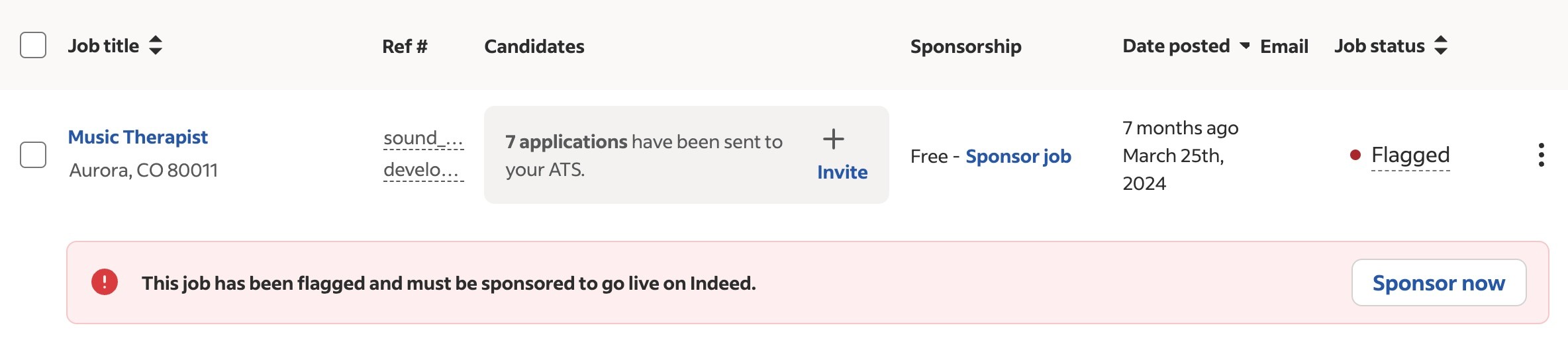
Some jobs may require sponsorship on Indeed based on factors like how the role is posted, the type of work, hiring urgency or patterns that suggest the posting needs additional review or verification. Sponsorship requirements can also help protect job seekers, prevent misuse of free listings and support a better overall experience on the site. Indeed may require a job ad to be sponsored for any or no reason at Indeed’s sole discretion.
Your job may have been flagged due to business model incompatibilities
Your job may also be flagged and permanently removed if the underlying business model is not compatible with Indeeds policies. This can include unpaid roles that are not allowed on the platform or models such as multi-level marketing or similar arrangements that are considered high risk for job seekers.
Your job post may have been flagged or reported by a job seeker
Job seekers can report suspicious, offensive or misleading job postings to Indeed, which may result in Trust & Safety reviewing the job for policy compliance. Job seekers may flag job posts for the following reasons listed below (although those reasons may not be limited to this list):
The job is offensive or discriminatory
Jobs that appear to discriminate based on gender, age, race, religion, disability or any other characteristic may be reported. Additionally, job seekers may report jobs that have inappropriate or explicit content.
The post has inaccuracies
There is at least one incorrect or inconsistent detail in the job title, description, salary, location or other key information. In many cases, you can resolve this by updating the job post so that all details are accurate, specific and aligned with the actual role.
The job is an advertisement
This is not a job post for an employment opportunity. This post is advertising services, promoting a company or app, or is a job seeker advertising their resume.
If the issue noted by the job seeker doesn’t meet one of the above reasons, the job seeker can simply choose “Other” when reporting the job and include their reasons in a detailed description.
Tips to create a high-quality job post on Indeed to help avoid getting flagged
While it may be frustrating when your job gets flagged, especially if you’re unsure why, consider using some of the following tips to help you create high-quality job posts and decrease your chances of getting flagged in the future.
Answer as many of Indeed’s prompts as you can
To help you create a complete and accurate job posting, fill in as many of Indeed’s prompts as you can. This can help reduce your chances of being flagged for an issue like incomplete information.
Include a high-quality job title
Use a job title that accurately describes the role without extra fluff, unnecessary symbols or clickbait. Avoid using misleading or overly promotional titles and save information about the company for the job description.
Write a high-quality job description
Keep your job description straightforward and clear by explaining what the role involves and what you expect from the new hire. Be honest and transparent, and don’t forget to highlight the benefits your company offers.
If you need help getting started or want a polished draft to build from, our Job Description Generator can help you create a clear, well-structured description based on the details you provide.
Other tips
By using these tips, you’re well on your way to crafting a job post that may be less likely to be flagged. Before finalizing your post, consider keeping these other considerations in mind:
- Only advertise high-quality opportunities. This means a job with consistent income and no job seeker fees.
- If your role is commission-based, break down the commission pay structure clearly within the job description. Low-quality sales roles may attempt to hide the pay structure or mislead candidates.
- Don’t repost the same job multiple times. Duplicate listings can be flagged as spam. If you need to refresh a listing, consider updating it instead of reposting it.
By following these tips, you may increase your chances of creating high-quality listings that attract the right candidates and decrease your chances of getting flagged.
Resolve flagged jobs quickly and keep your hiring goals on track
If your Indeed job post was flagged, it may be due to content or posting practices that fall outside of Indeed’s policies. These policies are in place to protect job seekers and maintain a platform they can trust, which in turn can help you attract the right candidates for your organization.
If your job post was flagged, click the link under the job in your employer dashboard to learn more about why and potential next steps.
For future posts, consider the tips provided in this article to craft compelling job posts that both follow Indeed’s policies and help you connect with quality candidates.
*Indeed provides this information as a courtesy to users of this site. Please note that we are not your recruiting or legal advisor, we are not responsible for the content of your job descriptions, and none of the information provided herein guarantees performance.
This article is based on product information available at the time of writing, which may change at any time. Indeed does not guarantee that this information is always up-to-date. Please seek out your CS/Sales rep for the latest on this topic.